
Table of Contents

In the daily-use glass bottle manufacturing industry, what truly creates a gap in final product quality, besides high-quality raw materials, the advancement of production machines, the experience of technical workers, and the completeness of the glass factory’s quality management system, is a very important link—the rational planning of the mold system. And within the mold system, apart from the design of each component, the internal venting system is almost invisible, yet it plays an incomparable and crucial role.
I have been working with glass bottles’ molds for more than twenty years and have seen too many projects: the design drawings for a bottle look beautiful, and the sample glass bottles look great in the showroom, but once continuous production begins, problems start to appear—slight haze on the surface, small bright spots on the shoulder, embossed logos becoming slightly blurred, and wall thickness data beginning to fluctuate. Many customer’s first reaction is that the molten glass is unstable, or that temperature control has deviated. In fact, the real root cause often lies in those micron-level vent grooves inside the mold cavity.

Today, based on my more than 20 years of experience, I will use simple words to introduce in detail how the mold venting system affects the quality of glass bottles for packaging.
First, what are the vent holes in glass molds and what is their function?
The vent holes arranged at different positions in a glass mold can be understood as “exits” reserved for the air inside the mold cavity. When molten glass, at a temperature as high as 1600–1700 degrees like lava, is quickly dropped from the gob chute into the mold during the press-and-blow or blow-and-blow forming process, and then rapidly pressed into the metal mold, the air originally occupying the mold cavity must be squeezed out immediately. Otherwise, this air will be trapped between the glass and the mold.
If the air cannot be discharged properly, it will act like a thin air cushion on the surface of the glass. The molten glass will not be able to adhere closely to the mold, eventually causing various appearance problems in the finished glass product, such as bright spots, orange peel texture, blurred engraved logos or patterns, or even incomplete filling in certain areas.
Vent holes are usually distributed along the parting line, at the highest point of the mold, or at the most complex patterned areas. The size of these holes is very small and almost invisible to the naked eye, but their function is extremely critical. Only when the air is discharged smoothly during mold operation can the glass be formed in high quality.
Vent holes are related to the following aspects:
- Whether the outer surface of the finished glass bottle is smooth and aesthetically pleasing.
- Whether the embossed patterns or logos in different positions are clearer.
- Whether the wall thickness of the bottle body is evenly distributed as designed.
- Whether the defect rate in production can be minimized.
- Whether the IS machine can run stably at target speed to achieve yield assessment.
It can be said that although these vent holes in glass molds are inconspicuous, they are important details to ensure that glass bottles are both beautiful and durable. In the production practice of the NEWRAY glass factory, we always regard the venting system as a core structure rather than an auxiliary design, because whether the molten glass can adhere evenly to the mold, whether it can fully fill the details, and whether it can still maintain structural strength under lightweight conditions, essentially depends to a large extent on how the air is orderly squeezed out of the mold cavity within less than one second.

Below, we will explain in detail from six aspects how the vent holes of glass molds affect different areas.
Ⅰ. Trapped Air Is Not Just an Appearance Issue
Taking a 500ml customized glass beverage bottle as an example, the mold cavity volume is close to 600–650 cm³, while the molten glass drops into the mold cavity in usually less than 0.5 seconds. Within this half second, the air in the mold cavity must be completely discharged instantly; otherwise, a gas isolation layer will form between the molten glass and the mold wall.
This isolation layer is invisible, but it will change the flow path of the near-liquid molten glass, forming local pressure rebound, which eventually appears as air holes or orange peel texture on the surface of the finished glass bottle, affecting the visual beauty of the beverage glass bottle.
We once encountered a similar problem in a 750ml high-flint glass water bottle project. During the trial production stage, slight orange peel texture appeared in the shoulder area under strong light, and the overall defect rate was close to 8%. After dismantling the mold, it was found that the vent groove depth at the highest point of the shoulder was too shallow, and the gas retention time exceeded the time window for molten glass to adhere to the mold.
Finally, we pulled the mold back to the mold repair workshop to re-optimize the vent path, controlled the groove depth within the range of 0.02–0.03mm, and slightly adjusted the cooling rhythm to synchronize gas release with glass flow. After sending it back to the production workshop and running it for one day, the surface defect rate dropped below 1.5%, and the effective output per shift increased by about 9%. What outsiders saw was that this pure water glass bottle looked “brighter,” but for us mold technicians, the real reason was that the airflow path during mold production became smoother.

Ⅱ. Air Discharge Determines the Clarity of Embossed Details
Newray not only produces glass beverage bottles and water glass bottles. When making high-end cream jars glass, luxury perfume glass bottles, or heavy premium spirit glass vodka bottles, brand embossing is often the core visual element. The embossing or logo letters may have a depth of only 0.5–0.8mm, but they must have clear outlines and sharp edges. This is the pursuit of every customer with embossing requirements and also an important standard for our online inspection of finished products.
During production, air in the mold naturally remains at the deepest part of the grooves. If vent holes are not precisely arranged, molten glass simply cannot completely fill these details within 0.1 seconds.
For example, when we recently developed a 120ml embossed spice shaker glass bottle for an Indian spice manufacturer, after the first trial mold, the edges of the letters were blurred, and several letters in the customer’s website address looked connected together. The customer believed it was an engraving precision issue, but after airflow simulation analysis, it was found that a local air pressure peak formed at the bottom of the groove, preventing the glass from fully adhering to the mold.
Later, we added micro-porous insert vent structures at the corners of the letters, controlling the groove width at about 0.02mm to ensure that the air had enough channels to be discharged before the glass arrived. After optimizing the mold system, the clarity of these letters improved to nearly 100%, and no blurring phenomenon occurred during 72 hours of continuous production.
In 2025, we cooperated with a British famous gin brand on two glass gin bottles750ml and 1000ml. Since the original design of the brand featured full-circle carvings, leaf veins, and bud engravings around the entire bottle body, the craftsmanship was extremely complex. During the one-month mold engraving process, our experienced mold technicians added several additional vent holes based on their judgment of the floral patterns to ensure the final clarity and delicacy of the carvings. Finally, with only one sampling, we achieved a result that satisfied the customer very much. The customer said, “This is exactly the feeling I wanted. It perfectly matches my expectations!”
Whether each engraving finally appears high-end on the glass bottle body depends not on how sharp the carving knife is, but on whether the air has retreated cleanly.

Ⅲ: In Lightweight Projects, Invisible Flow Regulation
Lightweight glass bottle manufacturing places higher and stricter requirements on the mold venting system. Because the key to successful weight reduction is not simply reducing a few grams of molten glass on the drawing, but allowing the glass to be more evenly distributed throughout the entire mold cavity under the premise of smooth gas discharge compared to ordinary non-lightweight bottles.
In our cooperation with a well-known hand craft beer brand on a 330ml brown beer bottle glass lightweight project, we reduced the single beer glass bottle weight by 10g. However, after trial production and cutting the sample bottle for beer evenly in half, we found that the side wall thickness fluctuation reached ±0.35mm. After structural analysis by industry experts, it was shown that it was not insufficient glass volume, but uneven vent distribution that caused slight deviation in the glass flow path.
After our team re-adjusted the vent hole distribution, the wall thickness deviation converged to ±0.18mm, and the burst pressure test range stabilized at 1.95–2.10MPa. It perfectly met industry standards and delivered satisfactory results to the customer. This successful weight reduction reduced at least 5% of the customer’s cost, and the customer was very satisfied.

Ⅳ. Production Efficiency Improvement Comes from Stable Venting Rhythm
If the venting system is not well designed at the initial mold stage, leading to poor venting during production, it will not only affect the appearance of finished products but also directly affect the production line yield and stability.
In a 72-hour continuous production comparison test, we recorded the following changes:
For a 500ml kombucha tea glass bottle production, before vent optimization the defect rate was around 9%; after optimization it dropped below 3%. Unplanned downtime was reduced by nearly 40%, and overall equipment effectiveness (OEE) increased from 82% to above 90%.
After the venting became smooth for this mold, carbon buildup was reduced, and the mold cleaning cycle was extended from once every 4 hours to more than 10 hours. This greatly improved our working efficiency. These small vent holes contributed significantly to cost reduction.
For increasingly competitive export orders, stable production itself is a cost advantage. The efficient and high-quality cooperation system between mold engineers, production technicians, and quality inspectors provides optimal packaging for our foreign trade sales team, enabling them to confidently deliver satisfactory finished products to customers.

Ⅴ. Vent Design Is Not Simply Drilling Holes
Many people think venting is just drilling a few holes along the parting line. In reality, it is not that simple. Each vent groove must strike a balance between size and function. If the groove depth is too large, glass may overflow and form burrs, appearing as regular dots on the bottle wall. If the groove depth is insufficient, air cannot be discharged in time, leading to the various problems mentioned above.
In our mold processing, we usually control the groove width between 0.02–0.05mm, depth tolerance within ±0.005mm, and surface roughness at Ra < 0.4μm. However, different glass materials have different flow viscosities, so the venting rhythm must also match. High flint, crystal flint, and standard flint glass differ significantly in temperature and flow properties, so vent density must be adjusted accordingly.
Therefore, how to design vent holes and how many to add do not have a completely unified formula. It is not something that can be solved once and for all on drawings, but an experiential system gradually formed through trial molding, recording, comparison, adjustment, and optimization.
Ⅵ. The Vent System Requires Continuous Maintenance
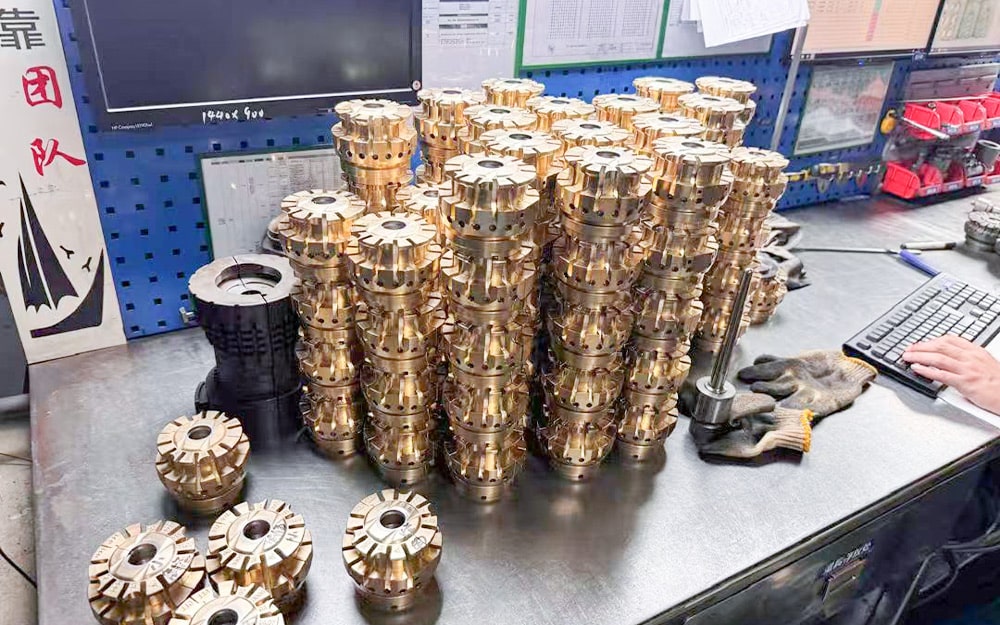
Vent grooves on molds are microstructures and are easily affected by lubricants and carbon buildup during long-term production. Once the venting system becomes blocked, the first change is often subtle surface abnormalities rather than equipment alarm signals. Therefore, careful maintenance by mold technicians is required.
Each mold component is like the mold technician’s child and needs careful inspection, wiping, sandblasting, and air blowing to maintain good condition throughout its lifecycle.
In Newray’s mold repair workshop, we have established a mold maintenance database to record the cumulative production cycles, production time, vent cleaning intervals, defect occurrence time points, and environmental data of each mold set. Through trend analysis, we perform maintenance in advance. This scientific and reasonable management method extends the average stable mold cycle by about 10%–15%, which also strongly supports cost reduction.

Overall Mold System Optimization Determines Glass Bottle Quality
The perfect presentation of a glass bottle is not only reflected in the design drawings but also in the mold material, craftsmanship, and whether every tiny internal venting path is reasonable. Whether the glass can flow smoothly depends on whether the air exits in an orderly manner.
When vent design is precisely calculated, repeatedly verified, and incorporated into a long-term maintenance system, quality no longer relies on chance but becomes a reproducible, controllable, and sustainable engineering result.
This is also the principle that we, as mold engineers and as Newray, have always adhered to—we firmly believe that the real difference is always hidden inside the mold.
